
Methadone Accountability Log: Reconciling by Volume
Published September 14, 2026
How pharmacies keep a methadone balance in mL: a worked daily log, normal measurement variance, pump calibration checks, and witnessed and carry doses.
Methadone concentrate is measured in mL, so its accountability log works differently from a tablet log. A tablet count is exact: either 92 tablets are on the shelf or they are not. A volume count carries a small amount of measurement uncertainty every day, from residue in measuring devices to the way a meniscus is read. A good methadone log accepts that, measures it, and watches the trend, so a genuine shortage is not lost among ordinary fractions of a mL.
The records that make up methadone accountability
- A daily balance log: opening volume, volume received, volume dispensed, measured wastage, expected and measured closing volume
- A dispensing record for each dose: patient, prescription, dose volume and date
- A witness record confirming a supervised dose was taken in the pharmacy and by whom it was observed
- A carry record for take-home doses, including the number of containers and the volume in each
- A calibration log for any pump or measuring device used to prepare doses
- Records of returned or unused carry doses, kept apart from stock and destroyed with a witness
Keeping a daily running balance in mL
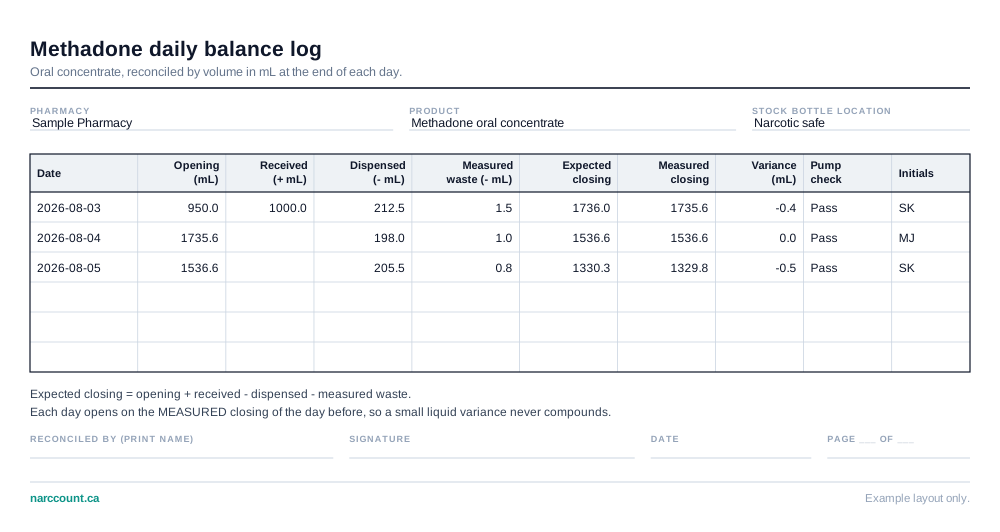
Here is a worked day. On 3 August the log opens with 950.0 mL. A receipt of 1000.0 mL is entered. Doses dispensed during the day total 212.5 mL, made up of 84.5 mL in witnessed doses and 128.0 mL in carries. Measured wastage, including the volume used for the morning pump check, is 1.5 mL. The expected closing balance is 950.0 + 1000.0 - 212.5 - 1.5 = 1736.0 mL. The stock bottles are measured at close and hold 1735.6 mL, so the variance is minus 0.4 mL, and the pharmacist initials the line. The next day opens on the measured 1735.6 mL, not the expected 1736.0 mL. Opening each day on the measured figure keeps small liquid variances from compounding into a large, meaningless number over weeks.
Small variances are normal, so watch the trend
Some loss is built into measuring a liquid: film left inside graduated cylinders and syringes, priming volume in pump tubing, and rounding on each dose. That is why a daily variance of a few tenths of a mL is ordinary and not a sign of anything wrong. What matters is the pattern. Suppose one week's daily variances read minus 0.4, 0.0, minus 0.5, minus 0.6, minus 0.3 and then minus 4.2 mL. The first five describe a pharmacy's normal measuring loss. The last one does not, and it deserves the same investigation a missing tablet would get: recheck the measurement, review every dose and carry recorded that day, and check whether a spill or a pump problem was left unlogged. Many pharmacies also total the variances at each full reconciliation, since a steady drift larger than usual can matter even when no single day stands out.
Pump calibration before the first dose
A pump that delivers slightly more than it displays produces a shortage that looks like diversion and repeats every day. A calibration check at the start of the day catches that early. A typical routine:
- Dispense a set test volume into a calibrated graduated cylinder or onto a calibrated scale
- Record the volume requested, the volume measured and whether it falls inside the pharmacy's tolerance
- If it fails, recalibrate, test again and record both results before preparing any dose
- Record the test volume and any priming after a tubing change as measured wastage, so it does not appear as an unexplained variance
- Initial the check, so every day's doses can be tied to a verified device
Witnessed doses, carries and returns
Witnessed doses and carries leave the balance in the same way but create different paper trails. A witnessed dose is recorded with the volume and the name of the person who observed it being taken. Carries are recorded by volume per container, so a prescription with several take-home doses shows each one rather than a single total. When a patient brings back an unused carry, it is a patient return. It is recorded as received, stored apart from stock, never poured back into a stock bottle, and destroyed with a witness. Pouring a returned dose back into stock is one of the most common ways a methadone balance stops being trustworthy.
Counting on the right interval
Methadone is a narcotic, so it is reconciled on the narcotic interval for the province, which is monthly in Nova Scotia and Prince Edward Island. For every other province, see our guide to controlled substance inventory frequency in Canada. Many pharmacies with a busy methadone program also compare the measured closing volume with the log every day, as in the worked example above.
Tracking methadone volume with NarcCount
NarcCount imports methadone dispensing and purchase records alongside other controlled substances, computes the expected balance and flags the variance against the measured volume. Because each reconciliation is kept as a dated record, a pharmacist can see whether small variances are holding steady or starting to drift.
More resources
NarcCount does the reconciliation math for you and flags every variance. Get started or read the worked reconciliation example.
General information, not legal or professional advice. For authoritative requirements, refer to the Ontario College of Pharmacists and Health Canada.