#150

Narcotic reconciliation · Canada
Reconcile your narcotics in minutes, not days.
NarcCount calculates expected inventory from your purchase, dispensing and destruction records, flags every discrepancy, and produces inspection-ready reports — purpose-built for Canadian pharmacies.
From $59/month · No setup fees · Cancel anytime
Reconciliation · Sep 2026
1 to reviewDILAUDID Hydromorphone HCl 2 mg
exp 480 · cnt 480
SUPEUDOL 5 Oxycodone HCl 5 mg
exp 312 · cnt 312
KADIAN Morphine sulfate 100 mg
exp 1,000 · cnt 994
3 items · 1 varianceReport ready →
Data hosted in Canada Keep your history when you switch OCP & Health Canada workflows
01 · The pour
A count begins on the tray.
Someone tips the stock bottle out, counts what is physically there, and writes a number down. That part is yours. Everything after it is arithmetic — and arithmetic is what gets done at the end of a long shift.
- Units on the tray
- 1,786
- Products
- 3
- Interval
- 182 days
02 · The count
994 capsules — 19 sealed bottles, and one with a mark on it.
KADIAN Morphine sulfate 100 mg · DIN 02184451, supplied in white plastic bottles of 50. So 994 counts out as 19 full bottles and 44 loose in the 20th — the one crossed in marker, because it is open and it is not full. This is the half of a reconciliation no software can do for you, and the half everyone assumes is the hard part.
#2100
#3150
#4200
#5250
#6300
#7350
#8400
#9450
#10500
#11550
#12600
#13650
#14700
#15750
#16800
#17850
#18900
#19950
Open994
994
Counted, witnessed and written down at 08:40 on 2026-09-02.
03 · The reconciliation
What the records expect, against what the shelf held.
Expected on hand is the prior count, plus everything bought, minus everything dispensed and destroyed since. NarcCount pairs it off against your count one unit at a time, and shows you what is left over.
1,006 carried + 250 bought − 232 dispensed − 24 destroyed = 1,000 expected
−66 doses of a controlled substance with no record accounting for where they went. On paper that is a loss report. In practice it is almost never one — keep scrolling.
Expected1,000
Counted994
994 paired off. 6 did not.
04 · The answer
One record, two clocks.
A destruction of 6 capsules, witnessed, reference DEST-2026-0912. It happened on 2026-09-01, inside the interval. It was entered on 2026-09-03, after the count was taken. On the day, it was not yet in the window — which is the commonest cause of a narcotic variance there is.
Event date
2026-09-01
Count taken
2026-09-02 08:40
Entered
2026-09-03 11:05
| KADIAN Morphine sulfate 100 mg | Destroyed | Expected | Counted | +/− |
|---|---|---|---|---|
| On the day of the count | 24 | 1,000 | 994 | −6 |
| With the late record included | 30 | 994 | 994 | 0 |
The prior count on 2026-03-04 and this one on 2026-09-02 are 182 days apart — inside the six months the Ontario College of Pharmacists expects.
What you get
Everything you need to reconcile with confidence
Automated reconciliation
Expected on-hand is calculated from your purchase, dispensing and destruction records — so the math is done for you, and reconciliations that used to take hours take minutes.
Discrepancies, surfaced
Variances are flagged instantly and ranked, with one-click drill-down into the exact transactions behind every number.
Both clocks on every record
The date a transaction happened and the date it was entered are both retained, so a record filed after the count — the commonest cause of a phantom variance — is visible instead of invisible.
Inspection-ready reports
Generate a clean, printable reconciliation report or CSV for any count on demand — ready for college and Health Canada review.
Bulk import
Upload purchase, dispensing and destruction exports straight from your dispensing software. Unknown DINs are added automatically.
Built for Canada
Designed around CDSA and provincial college requirements, with your data hosted in Canada.
See it in action
Every variance, explained at a glance
A real reconciliation in NarcCount: expected on-hand computed per drug, discrepancies flagged, and one-click drill-down into the exact transactions behind every number.
- 01Open the countEvery count you have taken, with the date and whether it still needs a second signature.
- 02Read the summaryItems counted, discrepancies, shortages and sign-off state, before any scrolling.
- 03Expected, per drugPrior count, plus purchases, less dispensing and destructions — computed for every drug in the count.
- 04The variances, flaggedTick “Discrepancies only” and the count collapses to the drugs that did not balance.
- 05One click on the numberEvery figure behind the arithmetic is a link, not a footnote.
- 06The transactions behind itThe exact records, already filtered to that drug and to the reconciliation window.
narccount.ca — Q3 quarterly narcotic count


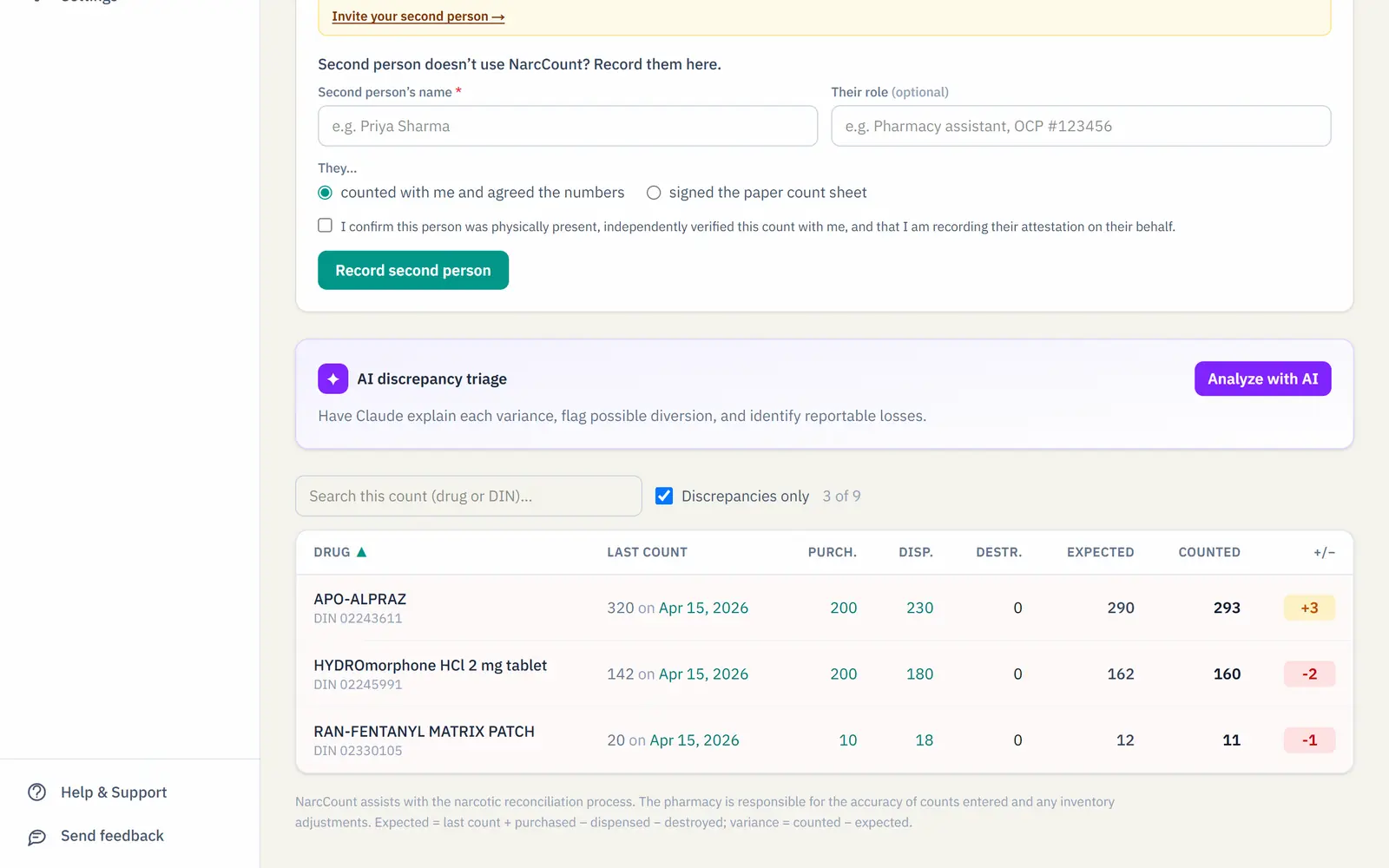


Real screens, captured 2026-09-06 on the Maple Demo Pharmacy sample tenant. Scroll to walk through it.
Built for compliance
Built around the rules you’re held to
NarcCount is designed around Canadian controlled-substance requirements, so a reconciliation is something you can hand to a reviewer with confidence.
OCP reconciliation requirement
Ontario pharmacies must reconcile narcotics and controlled substances at least every six months. NarcCount tracks the interval and keeps the records continuous.
OCP fact sheetHealth Canada loss & theft
A loss or theft of a controlled substance is reported to Health Canada's Office of Controlled Substances within 10 days of discovering it. NarcCount helps you catch and document them.
Health Canada guidanceCDSA recordkeeping
Built around Controlled Drugs and Substances Act recordkeeping — a clean, retrievable audit trail per drug, ready for college or inspector review.
NarcCount supports your reconciliation process; it does not replace your professional judgment or regulatory obligations.
Ontario · AIMS Program
Every Ontario pharmacy needs an incident management platform by January 1, 2027.
Every pharmacy needs a medication incident reporting platform, quarterly CQI meetings, unique logins for registered staff and a self-assessment every two years. NarcCount does all of that in the same account you reconcile narcotics in.
The AIMS module is free. Not free for a year — free. No end date, no per-user fee, no card at sign-up. Reconciliation is the part we charge for.
- What the College requiresThe Standard's four pillars, the mandatory data fields and the platform criteria — quoted, with sources.
- The eight-step checklistOCP's own checklist for Designated Managers, with the deadline against each step.
- Why the module is freeWhat is included, what is not, and the commercial reason, said out loud.
- Questions pharmacies askIncluding the ones where the honest answer about NarcCount is “not yet”.
Three steps
How it works
01
Import your records
Upload (or sync) your purchase, dispensing and destruction data.
02
Enter your physical count
Count your narcotics and key in (or upload) the quantities on hand.
03
Review & file
NarcCount reconciles instantly. Investigate variances, then export the report.
FAQ
Frequently asked questions
- How often does Ontario expect a narcotic reconciliation?
- The Ontario College of Pharmacists expects narcotics and controlled substances to be reconciled at least every six months, at minimum twice a year. NarcCount tracks the interval and keeps the records continuous.
- How long do I have to keep the records?
- In Ontario, pharmacy patient and dispensing records, which include your controlled-substance dispensing, must be kept at least 10 years (O. Reg. 264/16 s. 21), longer for a minor. Federally, narcotic and controlled-substance records must be kept at least 2 years (Narcotic Control Regulations s. 40.1; Food and Drug Regulations Part G s. G.03.010; Benzodiazepines and Other Targeted Substances Regulations s. 75).
- What actually causes a variance like the one on this page?
- Most often a record that was filed after the count was taken, so the count was checked against records that were not complete yet. Import the missing record and the variance is recalculated from it.
- Does NarcCount replace my dispensing system or the NMS?
- No. NarcCount is a reconciliation and recordkeeping tool. Your dispensing software and its real-time Narcotics Monitoring System submissions continue as they are; NarcCount checks your physical inventory against your records.
- Do I have to switch everything at once?
- No. Import your history and run your next count in NarcCount to confirm it reconciles before you retire your old process.
- Where is my data stored?
- In Canada, in our database provider's Canadian region (ca-central-1), with access restricted to your pharmacy's authorized users.
Ready to retire the count book?
Move your narcotic reconciliation onto a system that does the math for you.
Get started$69/month · $59/month billed annually · No setup fees · Cancel anytime
Integrations
Works with the software you already run
Import purchase, dispensing and destruction records straight out of your existing system. Step-by-step export instructions for each:
Not listed? Any CSV export works — see the upload guide.
Guides
Answers for Canadian pharmacy teams
Plain-language guides on reconciliation, recordkeeping and inspections. Every regulatory figure names the Act, regulation or college it comes from.
Guide: a narcotic reconciliation, worked end to endOne drug, one six-month window, the numbers written out — and three real causes of a variance worked through to zero.Read →- What to do after a narcotic discrepancy
A controlled substance didn't reconcile. Here's a calm, methodical way to find the cause — and know when a loss actually has to be reported.
- How often to count narcotics in Ontario
Ontario's OCP expects narcotics reconciled every six months. Nova Scotia and PEI monthly; Alberta, BC, Saskatchewan, Manitoba and Newfoundland every three.
- Health Canada narcotic loss and theft reporting
A loss or theft of a controlled substance is reported to Health Canada within 10 days of discovering it. What to gather, who submits it, and where the form is.
- CDSA recordkeeping: what to keep and how long
At least 2 years federally (three regulations, one per drug class); at least 10 years in Ontario (O. Reg. 264/16 s. 21). What to keep, and in what form.
- Preparing for a narcotics inspection
An inspector may ask to see how you manage controlled substances. A little preparation makes it routine — here's a practical checklist.
- Is a narcotic discrepancy reportable?
Not every count discrepancy is a reportable loss. What decides it is whether you can explain the variance, not whether it came out high or low.
- How Long a Pharmacy Keeps Records in Canada
In Ontario, pharmacy records are kept at least 10 years (O. Reg. 264/16 s. 21). Federally, controlled-substance records are kept at least 2 years.
- Controlled Substance Count Frequency in Canada
Narcotic reconciliation intervals by province, from monthly in Nova Scotia and PEI to twice a year in Ontario, and how to run each count well.
- Drug Diversion in a Pharmacy: Signs and Response
What drug diversion inside a pharmacy looks like, how to tell it from a record error, the patterns worth watching, and the controls that deter it.
- Narcotic Log Book Template for Canadian Pharmacies
The columns a narcotic log book needs, a worked page of entries, what separates a good entry from a weak one, and how to correct a mistake.
- Methadone Accountability Log for Pharmacies
How pharmacies keep a methadone balance in mL: a worked daily log, normal measurement variance, pump calibration checks, and witnessed and carry doses.
- Perpetual Inventory System Example for Pharmacies
A worked perpetual inventory example for a narcotic, the formula behind it, why balances drift, and how to keep a spreadsheet version honest.