
Controlled Substance Inventory Frequency in Canada
Published September 4, 2026
Narcotic reconciliation intervals by province, from monthly in Nova Scotia and PEI to twice a year in Ontario, and how to run each count well.
Canada has no single national schedule for counting narcotics and controlled drugs in a pharmacy. Each provincial regulator sets its own interval, and that interval is a minimum rather than a timetable. This guide sets out the intervals by province, explains what a reconciliation involves beyond counting tablets, and covers how pharmacies decide when to count more often and how to run a count day that produces a clean, signed record.
The interval by province
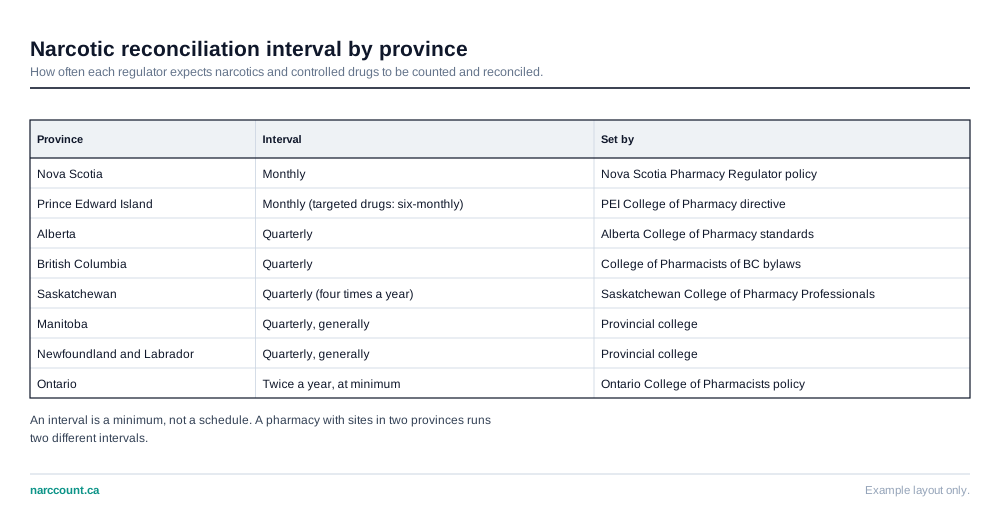
In Nova Scotia, the physical count and its reconciliation are completed and documented monthly. In Prince Edward Island, narcotic and controlled drugs are counted monthly as well, and targeted substances are reconciled at least once every six months. Alberta, British Columbia, Saskatchewan, Manitoba, and Newfoundland and Labrador generally require reconciliation every three months. The Ontario College of Pharmacists expects narcotics and controlled substances to be reconciled at least every six months, which works out to twice a year at minimum. Alberta's standard also calls for an audit of the perpetual inventory each time there is a change in proprietor or licensee. A pharmacy group with locations in two provinces runs two different intervals, and each location follows its own college.
What a reconciliation involves
A reconciliation is more than a tally. It has four parts: a physical count of each drug and strength, a comparison against the expected on-hand figure calculated from receipts, dispenses, destructions and returns since the last count, an investigation of every variance, and a signed and dated record of the result. A count that stops at the first part leaves a pharmacy with a number and no evidence that it matches anything.
Why many pharmacies count more often than the minimum
The difficulty of explaining a variance grows with the number of transactions behind it. Take a pharmacy that dispenses around 40 prescriptions of hydromorphone 2 mg between monthly counts. A shortage of 6 tablets on a monthly count means reviewing about 40 dispenses, a handful of receipts and any destructions. The same shortage found on a count at the Ontario minimum means reviewing roughly six times as many entries, and some of the staff involved may no longer remember them. A common approach is to tier the inventory: fast-moving and frequently diverted products such as oxycodone, hydromorphone, fentanyl patches and methadone get weekly or shift-change spot counts, while slow-moving items follow the full schedule.
Events that call for an extra count
- A change of owner, licensee or designated manager
- A break-in, a robbery, or a delivery that arrived with damaged or opened packaging
- A spot count that turns up a variance that a recount does not resolve
- A staff member leaving while a concern about controlled drugs is unresolved
- A conversion to new dispensing or inventory software, counted before and after
- Moving or replacing the narcotic safe or cabinet
- A change of wholesaler or a new receiving process
Running a count day
A count that produces a record an inspector can rely on usually follows the same order each time:
- Pick a cut-off time and hold new transactions for the drugs being counted until the count is done
- Print or export the expected on-hand figure for each drug and strength as of the cut-off
- Work in pairs where staffing allows: one person counts, the other records
- Count blind, writing down the physical quantity before looking at the expected figure
- Count sealed manufacturer packs by package and verify the seal; count opened bottles by unit; measure liquids by volume
- Compare the counts to the expected figures and recount anything that does not match
- Investigate each remaining variance and note the cause, or note that none was found
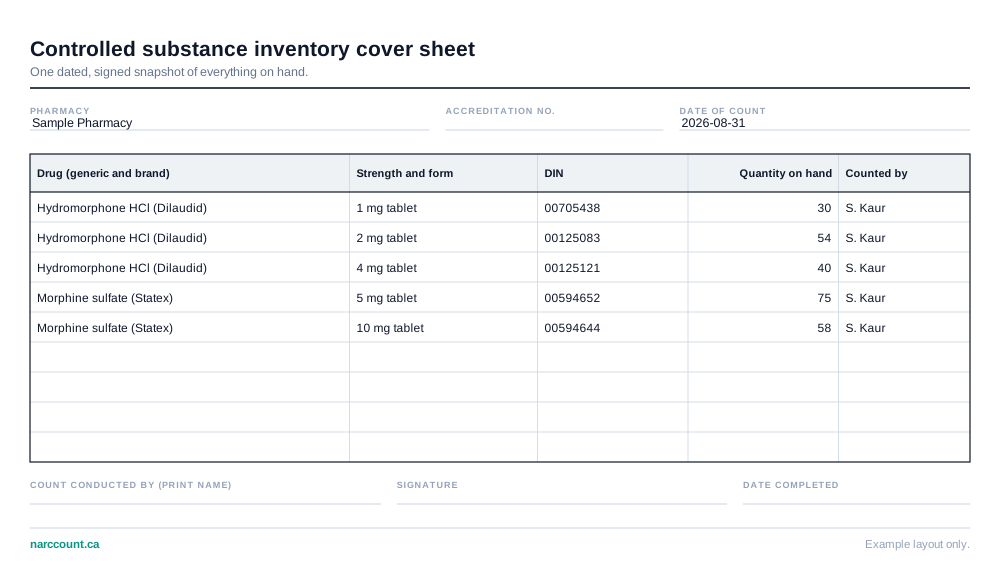
- Sign and date a cover sheet that lists every drug counted, so the count is one complete document
Spot counts between full counts
Spot counts catch problems while they are still small. At a shift change, the outgoing and incoming pharmacist can count two or three high-risk products, write the expected balance, the physical count and the variance, and both initial the line. If the expected balance of oxycodone 10 mg is 184 and the count is 182, the variance of minus 2 is recounted and traced before either person leaves, rather than discovered weeks later. For what to do when a variance does not resolve, see our guide on what to do after a narcotic discrepancy.
Keeping to a schedule with NarcCount
NarcCount imports dispensing, purchase and destruction records so the expected on-hand figure is ready at the cut-off, and it flags variances as soon as the physical count is entered. Each reconciliation is kept as a dated record, on whatever interval the pharmacy follows under its provincial college.
Sources
- O. Reg. 264/16 s. 21 (General, Drug and Pharmacies Regulation Act) — The 10 years runs from the last pharmacy service provided to the patient, and longer again for a patient who was a minor.
- OCP, Designated Manager — Medication Procurement and Inventory Management Policy — College policy the Designated Manager must follow, not a section of a statute. Six months is a minimum, not a schedule.
- College of Pharmacists of BC, PODSA Bylaws s. 23.8(6)(a) — British Columbia only — each province sets its own interval through its own college.
- Alberta College of Pharmacy, Standards for the Operation of Licensed Pharmacies s. 4.4.1(b)(ii)(A) — Alberta. Effective 1 February 2025 — “a documented audit of the perpetual inventories to verify accuracy … at least every three months, and each time there is a change in proprietor or licensee”.
- Nova Scotia Pharmacy Regulator, Policy: Inventory Management of CDSA and Z-Drugs — Nova Scotia is monthly — the physical count and its reconciliation must be “completed and documented monthly”, and the pharmacy manager must be able to show they reviewed that documentation monthly.
- PEI College of Pharmacy, Narcotic, Controlled and Targeted Drug Reconciliation Practice Directive s. 1.1 — Prince Edward Island. Updated February 2020 — narcotic and controlled drugs on a monthly basis; targeted drugs at least once every six months.
- Saskatchewan College of Pharmacy Professionals, Controlled Substances Record Keeping and Reconciliation s. 4.1 — “The inventory must be reconciled at least four times per year, or more often for high volume medications/prescriptions”.
- Narcotic Control Regulations s. 40.1 (narcotics) — Federal, and verbatim: “at least two years any records which they are required to keep by these Regulations” — these Regulations, meaning narcotic records only, which is why the other two below are also needed.
- Food and Drug Regulations s. G.03.010 (Part G controlled drugs) — The near-identical federal two-year rule for records a pharmacist keeps under Part G.
- Benzodiazepines and Other Targeted Substances Regulations s. 75 — Federal: two years for documents recorded under those Regulations, which is what covers benzodiazepines and the other targeted substances.
Primary sources for the figures on this page. Regulations change; confirm the current requirement with the source before you rely on it.
More resources
NarcCount does the reconciliation math for you and flags every variance. Get started or read the worked reconciliation example.
General information, not legal or professional advice. For authoritative requirements, refer to the Ontario College of Pharmacists and Health Canada.